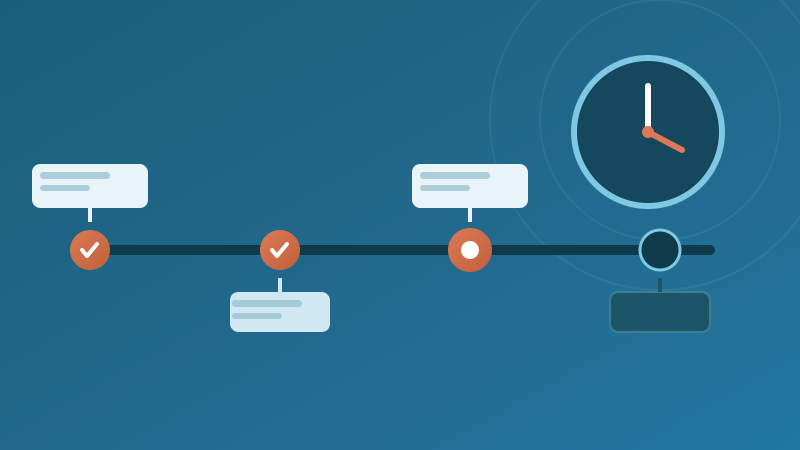
Most San Diego workers compensation claims close within six to eighteen months, but the real timeline depends on whether your injury is accepted quickly, whether you need surgery, and whether your case ends up before a judge at the WCAB district office on First Avenue. A simple sprain at a Chula Vista warehouse can resolve in a few months. A disputed back injury for a Sorrento Valley lab tech, with two surgeries and a Qualified Medical Evaluator (QME) panel, often runs past a year.
Here is what each stage actually looks like in San Diego County, with the deadlines California law puts on your employer and its insurance carrier.
The First 30 Days: Reporting, DWC-1, and the 90-Day Decision Clock
The clock starts the moment you tell your supervisor you were hurt at work. Under California Labor Code Section 5400, you have 30 days to give notice of your injury. In practice, San Diego employers (from Naval Base point-of-care clinics to Gaslamp restaurant managers) hand you a DWC-1 claim form within one working day, as required by Labor Code Section 5401.
Once you sign and submit the DWC-1, the insurance carrier has 90 days to accept or deny the claim. That window is the Section 5402 presumption: if the carrier does not deny in writing within 90 days, the injury is presumed compensable. While the carrier investigates, it must authorize up to $10,000 in medical treatment.
Get a free San Diego workers comp case review
Get a free San Diego workers comp case review ›In my experience filing claims out of Cohen and Associates, the 90-day window is when most paperwork problems surface. The carrier will ask for recorded statements, demand prior medical records, and sometimes schedule you with a defense-side doctor. None of that pauses the deadline.
Months 1 to 3: Medical Treatment Inside the MPN
Almost every San Diego employer uses a Medical Provider Network, or MPN. Within the first month, you should be receiving treatment from an MPN doctor (often in Mission Valley, Kearny Mesa, or the Sorrento Mesa medical corridor) and following a written treatment plan.
Two things determine how fast this stage moves:
- Utilization Review (UR). Every recommended treatment goes through UR. The carrier has five working days to decide on most requests under Labor Code Section 4610.
- Independent Medical Review (IMR). If UR denies your MRI, your physical therapy, or your surgery, you have 30 days to file an IMR appeal. IMR turnaround is typically about 30 to 45 days.
For straightforward injuries (a sprain, a small laceration, a contained back strain), treatment finishes inside three months and your doctor reports you back to your regular duties. For anything that needs imaging, injections, or surgery, expect this stage to stretch into months four through twelve.
Months 3 to 9: Reaching Maximum Medical Improvement
Maximum Medical Improvement, or MMI, is the moment your doctor decides your condition is as good as it will reasonably get with continued treatment. MMI is the gate to a permanent disability rating, and nothing about your case truly settles until you reach it.
For a San Diego construction worker who falls off scaffolding in East Village and needs a lumbar fusion, MMI typically lands eight to fourteen months after the injury. For a hotel housekeeper in the Gaslamp with chronic shoulder tendinitis, MMI is often six to nine months out, after a cortisone injection or two and a course of physical therapy.
Once your treating physician declares you Permanent and Stationary (the older California term still used in reports), they issue a Permanent and Stationary report. This document drives every dollar of your permanent disability award.
Months 6 to 12: The QME Process When Things Are Disputed
If you and the carrier disagree about the cause of your injury, the body parts involved, or the percentage of permanent impairment, the case goes to a Qualified Medical Evaluator. The QME timeline in San Diego County looks roughly like this, under Labor Code Section 4062.2:
- You request a panel from the DWC Medical Unit. The panel of three QMEs arrives in about 20 calendar days.
- You strike one name, the carrier strikes one. The remaining QME is your evaluator.
- The QME appointment is supposed to happen within 60 days, though San Diego panels (especially orthopedic and pain medicine specialists in La Jolla and Hillcrest) often book out 90 to 120 days.
- The QME report is due 30 days after the exam.
Add 60 days for supplemental questions and panel disputes. A QME process from request to final report regularly takes four to six months in San Diego.
Months 9 to 18: Settlement Negotiations and the WCAB
The San Diego WCAB district office sits at 7575 Metropolitan Drive in Mission Valley, and most local cases that go to a hearing pass through this courthouse. There are two main settlement paths:
Stipulations with Request for Award. You keep future medical care. The carrier pays your permanent disability over time. This works well for workers who want continued treatment in the MPN for a serious orthopedic injury.
Compromise and Release (C&R). You take a lump sum. You waive future medical care for the body parts settled. This is common for workers who do not trust the MPN, are leaving California, or have a denied case they want to resolve.
A typical San Diego mediation or Mandatory Settlement Conference (MSC) is set 60 to 120 days after either party files a Declaration of Readiness. If you cannot settle at the MSC, the judge sets a trial within 30 to 75 days.
What the typical San Diego case looks like
For a planning baseline, here is a realistic map of an accepted claim with one surgery:
- Month 1: DWC-1 filed, carrier accepts, MPN doctor assigned.
- Months 2 to 6: Conservative treatment, imaging, possible injection.
- Month 7: Surgery authorized through UR or IMR.
- Months 8 to 12: Surgery and post-op physical therapy.
- Month 13: MMI declared; Permanent and Stationary report issued.
- Months 14 to 17: QME (if disputed) and negotiation.
- Month 18: Stipulations or C&R approved by a WCAB judge.
Get a free San Diego workers comp case review
Get a free San Diego workers comp case review ›What Can Slow Your Claim Down in San Diego County
Three things stall San Diego claims most often. First, QME scheduling backlogs in specialties like neurology and orthopedic spine, especially in the I-15 corridor. Second, employer disputes about whether the injury is industrial (common in repetitive-strain claims from biotech, software, and gig delivery work). Third, missed deadlines on your side, especially the 30-day IMR window.
If you change jobs, move out of state, or stop responding to mail from the carrier, the case will sit. The WCAB will not move it forward without a Declaration of Readiness from one of the parties.